Quick answer: Egypt exports minerals, manufactured goods, agricultural products, food, chemicals, textiles, medical products, and building materials. In the official Egyptian 2025 report, gold was the largest listed individual export product at USD 7.602 billion. Building materials were the largest reported export sector at USD 14.880 billion.
This guide separates two questions that are often mixed together: what Egypt exports most and which Egyptian product may fit a particular buyer. The values below come from the GOEIC annual foreign-trade report for 2025. They describe completed trade, not a promise that a product will be profitable in every destination.
Editorial review: 1 August 2026. Values are shown in US dollars as published in the official report.
What does Egypt export?
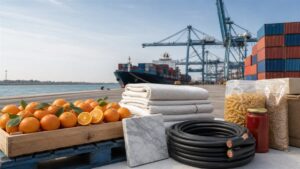
Egypt has a diversified export base rather than a single dominant consumer product. Major groups include gold and mineral products, fertilizers and chemicals, electrical cables and engineering goods, citrus and other agricultural produce, processed food, ready-made garments, textiles, cement, stone, medical products, furniture, and packaging.
Export value shows where trade already exists. A buyer still has to test demand, landed cost, product compliance, supplier capacity, and repeat-order reliability in the destination market.
Use the Egyptian Export Portal product and destination map or UN Comtrade to check which destinations already buy a specific HS code from Egypt. Use the ITC Export Potential Map as a second research view. Do not select a product only because its national export value is high.
Top Egypt export products in 2025
The following table follows the order and values published by the Egyptian General Organization for Export and Import Control. The official list places fruit and nuts in eighth position and copper wire in ninth even though the published copper value is higher. The table preserves that source order and exposes the values so readers can compare them directly.
| Official rank | Export product | 2025 export value |
|---|---|---|
| 1 | Gold | USD 7.602 billion |
| 2 | Nitrogen fertilizers | USD 2.014 billion |
| 3 | Insulated wires and cables | USD 1.740 billion |
| 4 | Products derived from petroleum oil or crude oils | USD 1.570 billion |
| 5 | Fresh citrus fruit | USD 1.044 billion |
| 6 | Suits and blazers | USD 913 million |
| 7 | Cement | USD 875 million |
| 8 | Fruit and nuts | USD 751 million |
| 9 | Refined copper wire | USD 800 million |
| 10 | Monitor displays | USD 750 million |
Gold and petroleum products are large trade categories but usually require very different capital, licensing, logistics, and counterparty controls from food, garments, or building materials. A high national export value is therefore evidence of an established category, not a buyer recommendation.
Largest Egyptian export sectors in 2025
Sector totals help reveal the production and supplier ecosystems behind individual products. They also show where Egypt has several related goods rather than one isolated commodity.
| Export sector | 2025 value | Change from 2024 |
|---|---|---|
| Building materials | USD 14.880 billion | +37% |
| Chemicals and fertilizers | USD 9.419 billion | +7% |
| Food industries | USD 6.803 billion | +11% |
| Engineering and electronic goods | USD 6.468 billion | +13% |
| Agricultural crops | USD 4.692 billion | +0.5% |
| Ready-made garments | USD 3.394 billion | +20% |
| Spinning and textiles | USD 1.167 billion | +2% |
| Medical industries | USD 996 million | +22% |
| Printing, packaging, paper, and books | USD 935 million | -2% |
| Furniture | USD 427 million | +22% |
These are broad sector totals. A buyer must move from the sector name to an exact specification. Marble needs a stone type, dimensions, finish, tolerance, and packing method. Citrus needs a variety, grade, size, residue limits, packing format, harvest window, and cold-chain plan. Cables need the exact standard, conductor material, cross-section, test reports, and destination conformity.
Which Egyptian export products fit different buyer profiles?
This screening matrix is a practical way to narrow the list. It does not replace destination rules, a landed-cost model, or supplier due diligence.
| Category to research | Typical buying situation | Evidence to request first | Main risk to test |
|---|---|---|---|
| Packaged and processed food | Retail, wholesale, or private label | Ingredient list, shelf life, label file, factory certification, and product registration evidence | Destination labeling, allergens, shelf life, and batch consistency |
| Fresh citrus, fruit, and vegetables | Seasonal wholesale or food service | Variety, grade, harvest window, packhouse evidence, phytosanitary route, and cold-chain plan | Residues, temperature control, arrival quality, and seasonality |
| Garments and home textiles | Retail, uniforms, hospitality, or private label | Fabric composition, weight, size set, colorfastness tests, sample, and production capacity | Sizing consistency, defects, color variation, and delivery schedule |
| Marble, granite, ceramic, and cement | Construction or project supply | Physical sample, dimensions, finish, test certificate, loading plan, and breakage allowance | Specification mismatch, weight, breakage, and freight cost |
| Cables and engineering goods | Project or industrial procurement | Applicable standard, technical data sheet, test report, traceability, and warranty terms | Conformity, counterfeit documentation, and technical mismatch |
| Fertilizers and chemicals | Industrial or agricultural distribution | Composition, safety data sheet, registration status, packaging, and dangerous-goods classification | Licensing, hazardous transport, composition, and destination restrictions |
| Medical products | Regulated distribution or institutional supply | Manufacturer license, product registration, quality-system evidence, batch traceability, and storage conditions | Market authorization, claims, sterilization, and traceability |
For a wider product shortlist, use the Egyptian products list after reading this data page. That page should support product discovery while this page remains focused on export statistics and category comparison.
How to compare Egypt export products before requesting quotes
- Start with destination demand. Record the wholesale price, retail price, seasonality, current suppliers, substitutes, and likely order frequency in the target country.
- Choose the exact HS code and specification. Broad labels such as food, marble, or garments are not quote-ready requirements.
- Check existing trade. Use the Egyptian Export Portal product and destination map and UN Comtrade to see whether the product already moves from Egypt to the target market and whether the pattern is consistent.
- Model landed cost. Include the product price, inland transport, inspection, documentation, freight, insurance, duties, taxes, storage, finance cost, expected loss, and returns.
- Compare like with like. Use the same quantity, specification, packing, Incoterm, destination, payment schedule, and inspection condition for every supplier quote.
- Test a sample or controlled first order. Define written acceptance limits before scaling the order.
If you need the operational sequence after choosing a category, continue to the export procedures in Egypt guide rather than treating this statistics page as a complete shipment procedure.
Supplier and document checks for products exported from Egypt
The Egyptian Export Portal exporter directory is a useful discovery source but a listing is not a guarantee of current capacity, certification, or product quality. Verify the legal entity, factory or packhouse, export registration where applicable, certificate scope, production capacity, references, sample, and batch before payment.
| Check | What to compare | Why it matters |
|---|---|---|
| Legal identity | Company name, registration number, address, bank beneficiary, and contract party | Prevents paying an unrelated person or entity |
| Product specification | Material, grade, size, tolerances, composition, test method, and acceptance limit | Turns a product name into an enforceable requirement |
| Capacity and timing | Monthly capacity, current workload, lead time, season, and backup plan | Tests whether repeat orders can be delivered |
| Certificate evidence | Certificate number, issuing body, facility name, scope, product, and expiry | A logo or image alone does not prove coverage |
| Sample and inspection | Reference sample, inspection stage, sampling method, defect limits, and remedy | Reduces disagreement after production |
| Payment and documents | Payment milestones, inspection release, invoice, packing list, origin proof, and transport document | Aligns payment with verifiable progress |
The exact document set depends on the product and destination. Common commercial documents include a commercial invoice, packing list, transport document, and proof of origin. Food, plants, chemicals, electrical goods, and medical products may require additional certificates, registrations, permits, or tests. Check the destination authority and use a tool such as EU Access2Markets for EU requirements before shipment.
Frequently asked questions about Egypt exports
What is the biggest export product from Egypt?
In the official 2025 GOEIC commodity list, gold ranked first at USD 7.602 billion. The answer changes when products are grouped into broader sectors, where building materials were reported at USD 14.880 billion.
What agricultural products does Egypt export?
Egypt exports citrus fruit, other fruit and nuts, vegetables, herbs, and additional crops. The official 2025 report valued the agricultural-crops sector at USD 4.692 billion. Product and destination requirements still need separate verification.
Are Egyptian textiles and garments major exports?
Yes. Ready-made garments were reported at USD 3.394 billion in 2025 and spinning and textiles at USD 1.167 billion. Buyers should compare fabric composition, tests, size consistency, factory capacity, and delivery terms rather than category value alone.
Where can I find Egyptian exporters?
Start with the official Egyptian Export Portal exporter directory, export councils, industry associations, and relevant trade fairs. Treat every listing as a lead for verification rather than an endorsement.
What documents are normally needed to import from Egypt?
A commercial invoice, packing list, transport document, and proof of origin are common. The exact set varies by product and destination and may include health, phytosanitary, conformity, safety, registration, or inspection documents.
Does a high export value mean a product is profitable to import?
No. Export value proves that trade exists but does not establish demand, margin, compliance cost, freight efficiency, supplier reliability, or competition in a particular destination.
Sources and calculation method
- GOEIC annual foreign-trade report for 2025
- Egyptian Export Portal product and destination map
- Egyptian Export Portal exporter directory
- UN Comtrade
- ITC Export Potential Map
- EU Access2Markets
The 2025 product and sector values are transcribed from the official GOEIC annual report. Other linked tools are provided for product, destination, supplier, and requirement research. Values are descriptive historical trade data. They are not forecasts, supplier endorsements, or guarantees of profit.